ACYVerse
Gamification Meets Regulation
A design exploration into gamified trading. how far can engagement mechanics go before they cross the line from education into encouragement? Navigating the hardest design tension in fintech.
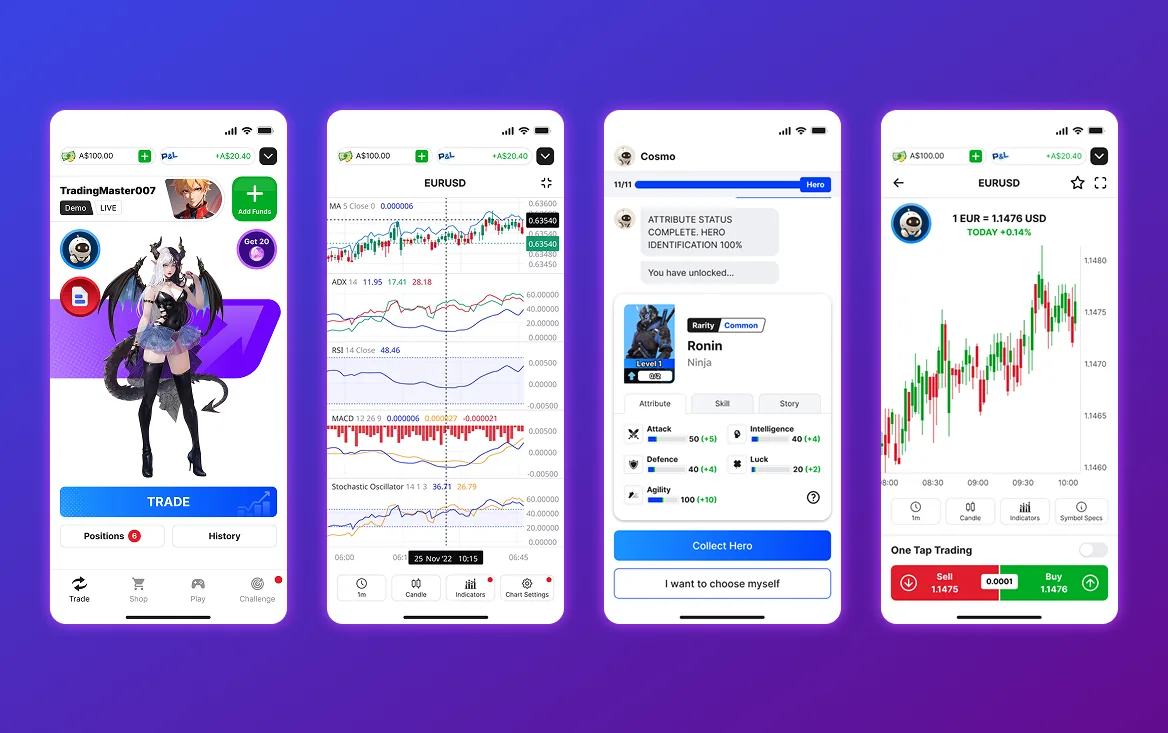
⚠️ Context: This Project Did Not Ship
ACYVerse was a 6-month design exploration into gamified trading — 3D environments, achievement systems, and algorithmic market educators. Internal legal review identified that certain mechanics risked conflicting with ASIC's inducement prohibitions, and the project was shelved before external launch. The compliance thinking developed during this process — particularly the distinction between engagement mechanics and inducement — carried forward into subsequent ACY product work.
The Question Behind the Brief
Retail trading platforms face a persistent retention challenge: most new traders disengage within their first 90 days. Most leave not because they lost money, but because they never understood the platform well enough to develop a strategy. Traditional trading interfaces assume expertise. Gamified approaches promise accessibility. But in regulated financial services, the gap between "making trading fun" and "encouraging gambling" is razor-thin.
Engagement vs. Encouragement
ASIC explicitly prohibits design patterns that "encourage" trading activity. Achievements for "completing 100 trades" could be interpreted as inducement. Every gamification mechanic had to be auditable against regulatory intent. not just regulatory letter.
Education Without Infantilization
Experienced traders would reject anything that felt like a "game." New traders needed scaffolding. The same platform had to serve both audiences without alienating either. the classic expertise tension in product design.
Virtual ≠ Risk-Free
Immersive 3D environments and avatars could create psychological distance from real money. Users who "lose gold in a game world" process risk differently than users who "lose $5,000 in a trading account." The abstraction layer was a feature and a danger.
What I Explored
The concept evolved through three phases, each testing how far gamification could stretch before breaking either regulatory constraints or user trust:
Phase 1: Trading Quests & Achievements
Designed a quest system where users completed structured learning paths: "Understand Leverage" (interactive simulation), "Build Your First Watchlist" (portfolio construction), "Set a Stop-Loss" (risk management). Achievements rewarded knowledge acquisition, not trading volume.
Design decision: No achievement ever rewarded placing a trade, number of trades, or profit amount. All rewards tied to learning completion, risk management actions, or strategy documentation.
Phase 2: Algorithmic Market Educators
Conceptualized rule-based characters that provided context-specific market education. Instead of a chatbot that says "buy EURUSD," a character that says "here's why EURUSD is moving today, and here's what that means for your open position." The system served as an explanatory layer, not a recommendation engine.
Design decision: Algorithmic advisors were explicitly positioned as educators, never trade recommenders. Each explanation included disclaimers surfaced through natural dialogue, not legal boilerplate. making compliance feel conversational rather than adversarial.
Phase 3: Social Interaction Hubs
Designed virtual spaces where users could share trading strategies, discuss market events, and form study groups. Think "trading Discord meets spatial computing". but with content moderation designed for regulated environments. No specific trade signals allowed, only educational discussion.
Design decision: Social features prevented sharing of specific trade signals or P&L screenshots (which could constitute unlicensed financial advice). Instead, users shared strategy frameworks, learning milestones, and market analysis. education over inducement.
The Process Gap: Design Before Legal Validation
The V1 prototype was built over 6 months — 3D environments, achievement systems, social mechanics — before being reviewed by ACY's legal and compliance team. Their assessment was that several mechanics, particularly particle effects on trade execution and achievement unlocks tied to trading activity, presented material risk under ASIC's inducement framework. The review identified this early enough to prevent external exposure, but too late to salvage the original vision.
The first prototype was visually spectacular. and legally unviable:
V1: IMMERSIVE GAME WORLD
- 3D environment with avatar customization
- Particle effects on trade execution
- "Level up" celebrations for milestones
- Virtual currency overlay on real trading
- Internal review flagged: "This looks and feels like a casino"
V2: EDUCATION-FIRST FRAMEWORK
- Clean interface with gamification as accent, not theme
- Progress bars for learning paths, not trading volume
- Quiet confirmation for trades, celebration for learning
- Real money always clearly visible, never abstracted
- Compliance approved: "This teaches, it doesn't encourage"
The V1 → V2 pivot was the most important design decision of this project. The principle: celebration should reward knowledge, never risk-taking. When a user completes a learning module about stop-losses, that's worth celebrating. When a user executes a trade, that should feel measured and deliberate. not exciting.
Mapping the Regulatory Line
Through iterating with ACY's legal team, I developed a framework for evaluating gamification mechanics against ASIC regulatory intent:
Gamification Compliance Framework
| Mechanic | Compliant Use | Non-Compliant Use |
|---|---|---|
| Achievements | "Completed Risk Management 101" | "Executed 100 trades this week" |
| Progress Bars | Learning path completion % | Trading volume toward next "tier" |
| Leaderboards | Strategy analysis quality score | P&L ranking among users |
| Animations | Subtle confirmation on trade | Fireworks / celebration on profit |
| Social Features | Strategy discussion forums | Real-time trade signal sharing |
What This Project Actually Produced
ACYVerse didn't ship as a standalone product. The concept was too ambitious for ACY's engineering resources, and the regulatory complexity would have required ongoing legal review that the company wasn't structured to provide. But the project's influence was substantial:
Compliance Framework
The gamification compliance table became a reference document used across all ACY products. When TradingCup added social features, when Finlogix added tutorial flows, when LogixTrader added onboarding. all referenced this framework to evaluate engagement mechanics.
Design Language
The V2 "education-first" aesthetic. clean interfaces with gamification as accent rather than theme. influenced the visual direction of subsequent ACY products. Celebration for learning, calm for trading became a design principle.
Algorithmic Advisory Patterns
The rule-based educator concept — explanatory rather than prescriptive — explored the same "explain, don't recommend" principle that Nova's contextual guidance would later apply in a different product context. A parallel approach to the same trust challenge.
Strategic Thinking
ACYVerse demonstrated that I could think beyond the immediate brief to explore strategic product directions. The CEO cited this project when expanding my role to include SPAC investor materials. it proved I could think at the intersection of product vision, regulatory constraint, and business strategy.
Reflection: Why "Concept Projects" Matter
ACYVerse is the project I'm most conflicted about including in a portfolio. It didn't ship. It was arguably overscoped from day one. But it taught me things that no shipped product could:
- The most interesting design problems exist at constraint boundaries. "Make trading fun" is an easy brief. "Make trading fun without triggering ASIC, without encouraging risk-taking, without alienating experts, and without infantilizing beginners". that's where the actual design thinking happens. The constraints didn't limit the design; they defined it.
- Failed concepts produce reusable frameworks. The gamification compliance table, the "celebrate knowledge / calm for trading" principle, the AI-as-explainer pattern. none of these existed before ACYVerse. They all influenced subsequent shipped products. The ROI of a concept project isn't the concept itself; it's the thinking patterns it generates.
- Know when to stop. I could have spent another 6 months trying to get ACYVerse to a shippable state. Instead, I recognized that the most valuable outputs. the frameworks and principles. were already extracted. Knowing when a concept has given you everything it can is as important as knowing when to push through.
Core insight: In regulated financial services, every engagement mechanic has a moral dimension. The line between "helping users understand markets" and "encouraging users to trade more" is not a design decision. it's an ethical one. ACYVerse forced me to develop a vocabulary for articulating that distinction, and that vocabulary has been more valuable than any specific UI I've designed.
🏦 B2C Private Banking Application: Compliance-First Engagement Design
ACYVerse's real output wasn't a gamification feature — it was a compliance framework for client engagement design: what's permitted (educational rewards, milestone recognition), what's prohibited (loss-aversion triggers, urgency mechanics, FOMO patterns). That framework applies directly to private banking digital engagement:
Engagement Without Inducement
ACYVerse V1 failed because celebrating trading activity — regardless of outcome — looked like inducement to trade under ASIC's regulatory lens. Private banking digital engagement faces the same constraint: notifications, portfolio alerts, and market insights that drive client interaction cannot look like urgency mechanics or trading inducements. The V2 framework I developed — celebrate learning and relationship milestones, keep transaction surfaces calm — is the same design philosophy private banking client communications should follow.
The Permitted / Prohibited Framework
ACYVerse produced a concrete framework distinguishing allowed from prohibited engagement mechanics. In private banking, this maps to: permitted — "Your Q3 portfolio review is ready" (relationship touchpoint), "Congratulations on reaching your 10-year wealth milestone" (celebratory, non-transactional). Prohibited — "Market moving fast — check your positions now" (urgency), "You're underperforming peers" (loss-aversion). The principle: private banking engagement should feel like a trusted advisor, not a trading app. Designing that distinction requires exactly the regulatory fluency ACYVerse developed.
Education as the Engagement Model
ACYVerse V2's insight: in regulated financial contexts, the only sustainable engagement model rewards knowledge acquisition, not action frequency. Private banking applies this at a higher level — UHNW clients who understand their portfolio strategy are more loyal, less reactive to volatility, and less likely to make emotionally-driven decisions. Client education content (market commentary, investment rationale, strategy updates) isn't marketing — it's the engagement mechanism that builds the long-term advisory relationship. ACYVerse taught me to design for that distinction before I'd articulated it.
Transferable principle: The hardest engagement design problem in regulated finance isn't building engagement — it's building engagement that a regulator would describe as educational and relationship-building, not as inducement or pressure. ACYVerse made that distinction concrete. Private banking client-facing design lives inside that same constraint.
Interactive Demo
Engagement Mechanics Compliance Simulator
Toggle mechanics on or off — the ASIC risk score updates live. This is the same mechanic-by-mechanic evaluation we ran during V2. The surprise was how quickly it flipped: a single high-weight mechanic (P&L leaderboard) could push a compliant concept into regulatory exposure.